
Generative AI is no longer a futuristic concept for eCommerce teams. It is quickly becoming an important tool that shapes how brands create content, personalize experiences, and support customers. Over the past year, the conversation has shifted from “What can AI do?” to a more grounded question: “Where does generative AI actually create value for eCommerce, and how do we start?”
Most retailers and DTC brands have already begun experimenting with AI tools, often starting with product descriptions or basic chatbots. These experiments are useful, but they do not automatically translate into meaningful business outcomes. The real opportunity comes from understanding which AI use cases deliver the highest ROI, how they fit into your existing technology stack, and what steps you need before scaling.
This guide is designed to help you move from noise to clarity. Whether you oversee eCommerce, marketing, product, or digital operations, you will find a practical explanation of how generative AI can make your teams more efficient, your customer journeys more relevant, and your core workflows more resilient.
We will walk through a simple maturity model, six high-ROI use cases and a simple setup that connects AI to your current systems.
The Generative AI Maturity Model for eCommerce
As GenAI becomes a bigger part of eCommerce, we’re noticing that most companies move through a pretty familiar growth pattern. At Doofinder, we see it all the time when teams start using AI to improve search, discovery, and on-site experiences. The same progression shows up across the industry too—whether you’re using AI for content creation, personalization, customer support, or managing your catalog.
Think of the spectrum below as a quick way to pinpoint where your organization is right now and what real progress looks like. It’s not about adopting every shiny new tool. It’s about building the right capabilities at the right moment so GenAI boosts performance instead of adding unnecessary complexity.
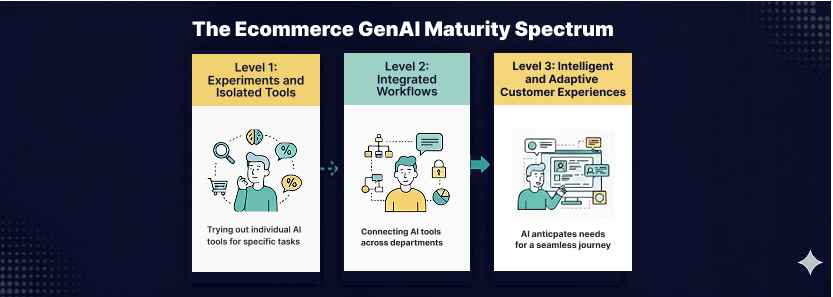
Level 1: Experiments and Isolated Tools
Most teams begin by testing GenAI on isolated, low risk tasks. These initiatives help build familiarity with AI but rarely produce transformational results yet.
Common examples include:
- Generating product descriptions or ad variations
- Running basic tests with AI powered chatbots
- Trying out AI search or recommendations without full integration
- Translating small parts of the catalog using automated tools
This stage helps teams understand what GenAI can do but also reveals a key insight. AI performs best when it is connected to structured product data and real customer intent, not when it is used as a standalone gadget.
Even at this early stage, tools like Doofinder help teams move faster—its AI-powered search is exceptionally easy to integrate, letting you plug it into your store with minimal effort and start seeing results immediately. You can try Doofinder for free
Level 2: Integrated Workflows
At this stage, generative AI stops being a one-off experiment and becomes part of your regular, repeatable workflows.
Content teams start using it to automate bigger chunks of their catalog. Search and discovery tools also get smarter by blending product data with what shoppers are actually looking for. AI begins to help with everyday merchandising tasks—things like generating tags, improving SEO, and creating localized versions of content.
Organizations here see more consistent results because data quality improves and tools are connected to the broader stack.
Common signs of Level 2 include:
- AI is built into your PIM, CMS, or eCommerce workflows.
- Your catalog gets richer thanks to automated attributes and metadata.
- You’re starting to personalize search, navigation, or on-site content.
- You have clear internal guidelines for brand voice and quality checks.
Level 3: Intelligent and Adaptive Customer Experiences
The most advanced brands move beyond automation and begin shaping real-time customer experiences with AI. Product discovery becomes conversational. Recommendations adapt to context and behavior.
Content personalizes itself for different segments or individuals. Teams use AI to make smarter decisions, not just faster ones. These companies track the impact of generative AI on conversion, AOV, support efficiency, and lifetime value.
Typical characteristics include:
- AI-assisted discovery experiences such as conversational search or guided shopping.
- Personalization across landing pages, collections, and promotional messages.
- Automated content production connected directly to inventory, pricing, and demand.
- Strong data foundations that support reliable, context-aware responses.
Most organizations do not need to reach Level 3 in every area of the business. The goal is to understand your current position, identify the high-value next step, and scale in a controlled, measurable way. This spectrum helps anchor those decisions and provides a realistic roadmap for unlocking meaningful value from generative AI in eCommerce.
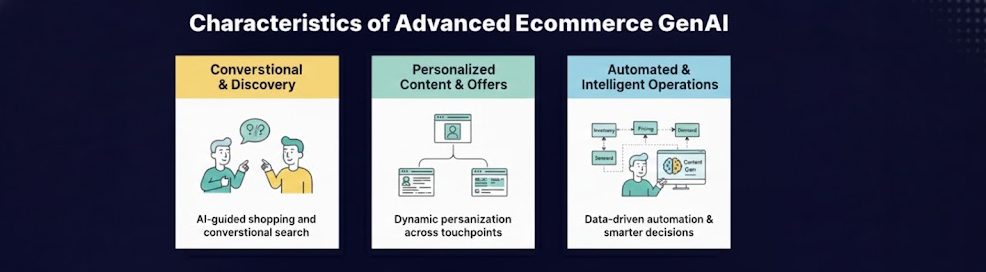
Six High ROI Use Cases for Generative AI in eCommerce
Brands across retail and eCommerce are experimenting with AI in dozens of ways, but most initiatives eventually fall into one of six categories. These use cases consistently deliver meaningful value because they improve efficiency, customer experience, or conversion. They also scale well, even for teams with limited resources.
Below are the six areas where generative AI creates the strongest return on investment for eCommerce organizations today.
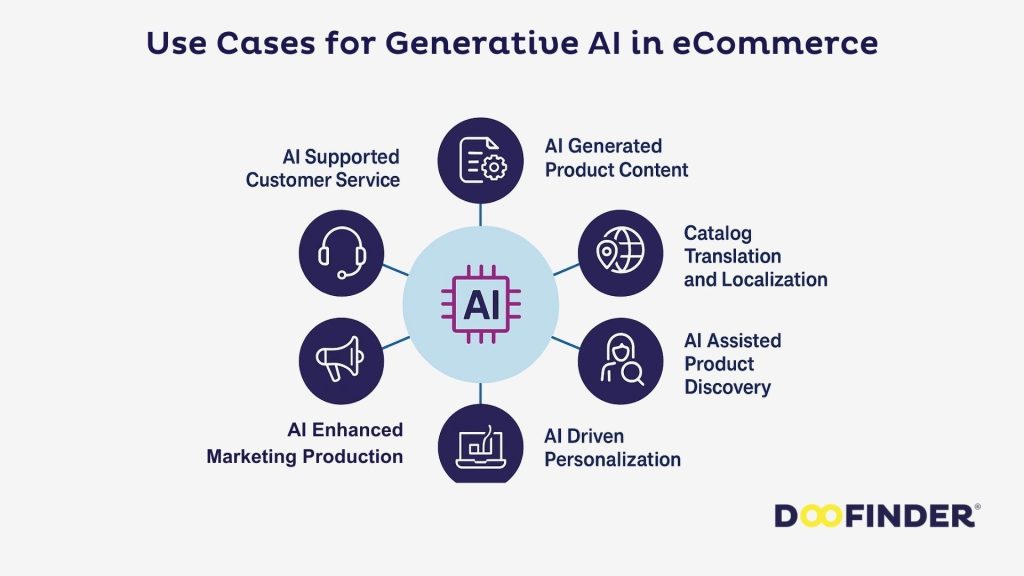
1. AI Generated Product Content
For many companies, the most immediate win comes from automating product descriptions, metadata, and SEO structured content. This is especially impactful for merchants with large or frequently changing catalogs.
Key advantages include:
- Faster content production at scale
- More consistent tone and structure
- Improved organic search performance
- Ability to generate multiple variations for A/B testing
AI can also assist with attribute extraction, categorization, and enrichment, which directly improves searchability and product discovery.
2. Catalog Translation and Localization
When you expand into new markets, you suddenly need thousands of product descriptions and marketing messages translated. Generative AI makes this much easier by producing accurate, on-brand translations that your team can simply review and refine instead of writing from the ground up.
Typical benefits include:
- Reduced reliance on external translation agencies
- Faster entry into new markets
- Ability to test localized product content in parallel
- More consistent customer experience across regions
Localized AI content can also be tailored to regional terminology, seasonal trends, and cultural nuances.
3. AI Assisted Product Discovery
Shoppers today expect intuitive search, relevant recommendations, and helpful guidance while browsing. Generative AI supports these goals through more natural, intent-aware interactions.
Examples of high value applications include:
- Conversational search that understands descriptive queries
- Smarter autocomplete suggestions
- Dynamic product recommendations based on real-time behavior
- AI guidance for complex or unfamiliar product categories
These enhancements reduce friction and help customers find what they want more quickly, which is strongly correlated with conversion uplift.
4. AI Driven Personalization
Generative AI lets you personalize the shopping experience in ways old rule-based systems just can’t. Instead of grouping customers into broad segments, it can tailor content, offers, and product displays based on what each individual shopper is doing or looking for.
In practice, this can look like:
- Homepages and landing pages that change based on the shopper
- Product grids or category layouts that adapt on the fly
- Personalized product messages or bundle recommendations
- Dynamic content blocks in emails and on-site campaigns
When you combine real-time behavior with generative AI, you usually see better engagement and higher average order value because the experience feels more relevant to every shopper.
5. AI Enhanced Marketing Production
Marketing teams spend significant time creating variations of ads, emails, product highlights, and promotional assets. Generative AI accelerates this work by producing first drafts, rewriting content for different audiences, or generating creative concepts.
Common applications:
- Email copy generation
- Paid ad variations for rapid experimentation
- Campaign ideation and message testing
- Automated SEO content generation
The advantage is not only speed but also the ability to test more creative directions without adding workload.
6. AI Supported Customer Service
Customer service is one of the areas where generative AI can reduce operational costs while improving response quality. AI can handle common questions, summarize customer history for agents, or propose draft answers that support consistency across the team.
The strongest results come from:
- Automated responses for high volume, low complexity tickets
- Generative summaries of product information or policies
- AI suggestions that speed up agent responses
- Multilingual support without staffing changes
This typically increases resolution speed and frees human agents to focus on complex or sensitive inquiries.
How Generative AI Fits Into Your eCommerce Stack
Generative AI works best when it enhances the systems and workflows you already rely on. Instead of replacing your eCommerce stack, it acts as an intelligence layer that connects your product data, customer interactions, and merchandising decisions. When implemented well, GenAI turns scattered data into actionable insights and scalable experiences.
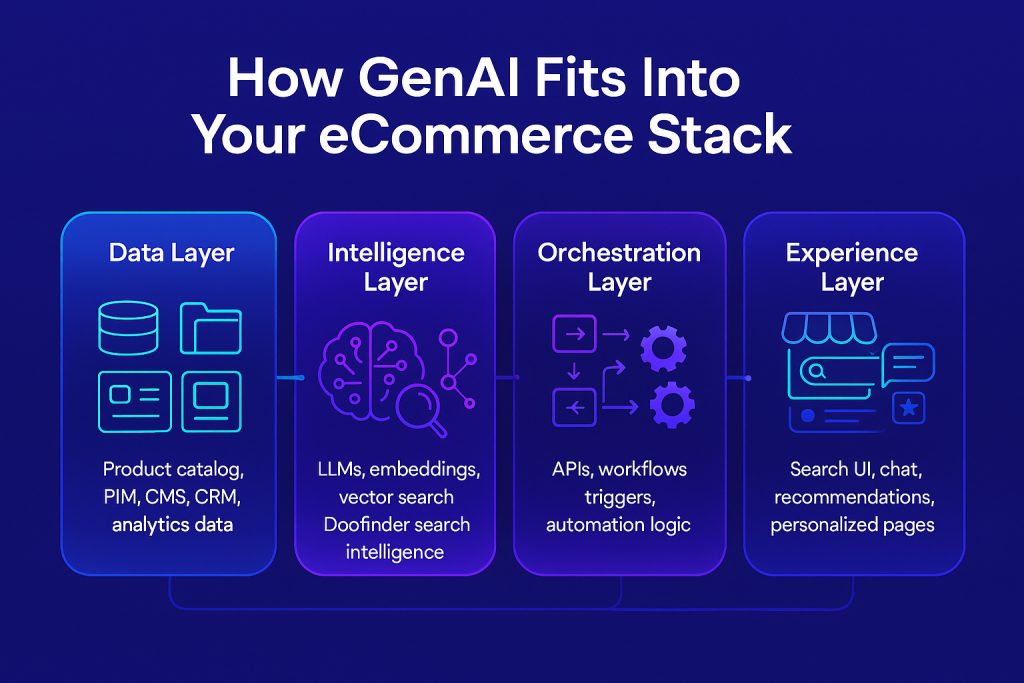
At a high level, an effective GenAI-enabled stack can be viewed in four layers.
Data Layer
Your product catalog, PIM, CMS, CRM, and analytics platforms provide the raw information GenAI needs. Product attributes, search terms, clickstream behavior, and customer profiles are the foundation. Poor quality data limits every downstream use case.
Intelligence Layer
This is the layer where tools like large language models (LLMs), embeddings, and vector databases come into play. It’s basically the “intelligence layer” that helps generative AI understand your content and how users behave. Whether you’re using engines like OpenAI or Anthropic, or running your own models locally, this layer mixes your data with the model’s reasoning abilities.
Search and discovery tools—like Doofinder—also support this layer by organizing your product and behavioral data in ways that make it easier for the AI to understand and work with.
Orchestration Layer
This layer coordinates how AI interacts with your systems. It includes APIs, automation workflows, event triggers, and the logic that determines when and how GenAI responds.
If you build an AI-driven search experience, an assistant for product discovery, or dynamic content generation, the orchestration layer is what ensures everything runs reliably behind the scenes.
Experience Layer
This is the layer customers actually interact with. Things like search bars, chat tools, product recommendations, and personalized page content all live here. Platforms such as Shopify, Magento, BigCommerce, or headless storefronts simply display whatever the intelligence and orchestration layers produce. The goal isn’t to make the AI noticeable—it’s to make the shopping experience feel smoother and more intuitive.
Across these layers, three practical principles tend to make GenAI implementations successful:
- Start where your data is strongest. Most teams begin with product content, search, recommendations, or support automation because these areas already have clean, structured data.
- Add AI to existing touchpoints instead of creating brand-new ones. Enhancing search, filters, or merchandising usually delivers more value than launching separate AI features.
- Keep humans in the loop. Even great models need periodic review—especially to maintain brand consistency and stay compliant.
With the right setup, GenAI becomes a flexible capability that grows with your eCommerce roadmap. Whether you use tools like Doofinder for product discovery or other AI-driven services for content and personalization, the goal stays the same: each layer works together to create faster, more accurate, and more relevant experiences for shoppers.
The Real Business Impact of GenAI in eCommerce
Generative AI is creating measurable impact across productivity, revenue operations, and—where data is strongest—operational efficiency. While many inflated statistics circulate in vendor materials, a smaller set of peer-reviewed, academically supported, and globally recognized studies provide reliable evidence. Below is a synthesis of what we can actually prove today.
1. GenAI’s Impact on Conversion Rates & Sales Performance
Research specifically tying GenAI to large-scale, causal conversion lifts in retail is emerging but still limited. The most credible public benchmark available comes from a large dataset analyzed by the Retail AI Council and published via Retainful:
- A recent large-scale randomized field experiment across a major online retail marketplace found that integrating GenAI into workflows lifted sales by up to 16.3%, depending on the AI use case.
- That same study showed the incremental value per consumer from AI-enabled improvements amounts to about US $5 per year — modest per person but meaningful at scale
What this means: When GenAI is used intelligently (e.g. smarter search, recommendations, content enrichment), retailers can realize measurable lifts in sales and conversion — not just marginal gains, but substantial, quantifiable impact.
GenAI’s Impact on Operational Efficiency & Productivity
- In a broader context, research into AI-driven marketing and analytics finds that tools like chatbots, personalization engines, and predictive analytics can significantly improve eCommerce performance, including efficiency in marketing execution, customer acquisition, and retention.
- According to a global survey of business leaders in 2025, nearly two-thirds (64%) report that their AI initiatives—when deployed at scale—are delivering cost or revenue benefits, highlighting that many enterprises are already capturing value from GenAI beyond pilot use.
What this means: GenAI doesn’t just help sell more — it enables leaner operations, better marketing scalability, and more efficient workflows, helping businesses do more with existing resources.
Conclusion: Turning GenAI Into Practical Advantage
Generative AI is no longer a side project for eCommerce teams. It is becoming part of how teams create content, help shoppers find what they want, and run day to day operations. The real value comes from using it on purpose, starting with strong data and applying it where it makes a clear difference.
This guide shows that when AI is connected to product data and real shopper intent, the results are tangible. Conversion improves, teams work more efficiently, and customer experiences feel more relevant. Search and discovery tools like Doofinder play an important role here by turning shopper intent into practical, AI driven results.
The goal is not to try every new AI tool that appears. It is to focus on the moments that matter most, including search, discovery, personalization, content, and support. Retailers who move beyond testing and make AI part of how they operate will be the ones that stay ahead.