The best AI shopping assistant for your store depends on three things: how big your store is, which platform you run on, and a question most buyers skip. Does the assistant run on a real search engine, or is it a chat layer bolted on top of the search you already have?
This guide compares eight AI shopping assistants and agents for eCommerce, from plug-and-play tools for growing stores to enterprise platforms that need a development team. For each one, you’ll see who it fits, which platforms it runs on, what it costs and where it falls short.
The tools are sorted by type of store, and we point out where another tool is the better choice.
The best AI shopping assistants at a glance
Prices are the published entry points for the assistant, checked on vendor pricing pages. Where a vendor doesn’t publish a price, the table says so.
| Tool | Best for | Runs on its own search engine | Platforms | Pricing |
|---|---|---|---|---|
| Doofinder | Stores of any size that want plug-and-play setup that scales, with search and assistant on one engine | Yes | Shopify, WooCommerce, Magento, PrestaShop, BigCommerce +30 more | On request; AI Assistant on Pro, Advanced and Enterprise plans; 15-day free trial |
| Rep AI | Shopify brands losing shoppers before checkout | No | Shopify (WooCommerce and Salesforce Commerce Cloud rolling out) | Billed on monthly sessions; Sales agent $104/mo at 10,000 sessions (monthly billing); 30-day free trial |
| Gorgias | Stores already running support on Gorgias | No | Shopify only for the AI Agent | Helpdesk tickets + automated AI interactions; $90/mo for Basic with AI Agent (monthly billing) |
| Dialog | Complex or premium products that need explaining | No | Shopify, Salesforce Commerce Cloud, BigCommerce, PrestaShop | Billed on unique monthly visitors; free plan, paid from $249/mo |
| Alhena AI | Beauty and fashion brands | No | Shopify, WooCommerce, Salesforce Commerce Cloud | Billed per conversation; free plan, paid from $199/mo (annual) or $239/mo (monthly) |
| Luigi’s Box | European stores that want search and assistant from one vendor | Yes | Shopify, Shoptet, Shopware, WooCommerce, PrestaShop, Magento, BigCommerce and more | On request, based on products used and usage |
| Algolia Agent Studio | Teams with developers who want to build their own | Yes | Any, via API and SDK | Usage-based: Algolia search usage plus your own LLM provider |
| Bloomreach Loomi | Enterprise retailers already on Bloomreach | Yes | Shopify, Magento, BigCommerce, headless | On request; module fee plus usage, with tiers by monthly visitors |
What does “runs on its own search engine” mean?
Some assistants are made by site search companies and use the same engine as your search bar. That means shoppers get the same products in the chat as in search, and your merchandising rules apply in both. Standalone assistants read your catalog separately and sit next to the search you already have.
How we chose the tools
We looked at these assistants the way we look at search: what they’re built on, where their answers come from and where they show up for shoppers.
What a tool needed to make the list
Every tool here had to meet four rules:
- It runs on the merchant’s own store, under the store’s brand.
- Shoppers can type freely, in their own words. Guided quizzes alone didn’t qualify.
- Answers come from the store’s live catalog, not from a generic model guessing.
- It answers product questions and recommends products before the purchase.
What we left out
Consumer tools like ChatGPT Shopping, Perplexity Shopping, Google Gemini and Amazon’s Alexa for Shopping are useful for shoppers, but they don’t run on your store. We cover them briefly further down.
Everything in this guide comes from each vendor’s own website, pricing pages and documentation, plus reviews on G2 and the Shopify App Store.

What is an AI shopping assistant?
An AI shopping assistant is software on your store that lets shoppers ask for what they need in plain language and get real products back. Think of a good sales associate: it asks a follow-up question, compares two options and tells the shopper whether the jacket runs small. For a deeper look at what these tools do day to day, see our guide to AI shopping assistant use cases.
How is an AI shopping assistant different from a chatbot?
A classic chatbot follows a script. It matches keywords to pre-written answers and breaks as soon as a shopper goes off-script. An AI ecommerce assistant reads the intent behind a question, pulls from your live catalog and keeps the context of the conversation.
Most chatbots were also built for support: order status, returns, opening hours. An AI shopping assistant works before the purchase, when someone is still deciding. We wrote more about that split in chatbots for eCommerce.
How is an AI shopping assistant different from AI search?
This is the question we get most, and the answer matters for your budget.
Search is for shoppers who know roughly what they want. They type “black running shoes size 10” and expect a results page. Good natural language search already handles longer queries like “comfortable shoes for standing all day”.
An assistant is for the questions search can’t answer. “What is EVA foam?” or “Will this sofa fit through a 30-inch door?” aren’t product queries, they’re decision questions. Search gets shoppers to the product. The assistant helps them buy it.
Here’s the part most comparison articles miss: an AI shopping assistant is only as good as the search engine and product data underneath it. If the assistant can’t find the right product for “waterproof jacket under $100”, a friendly tone won’t save the sale.
Best all-round AI shopping assistant: plug and play, built to scale
Doofinder runs AI search, merchandising, recommendations and the AI Assistant on one engine. It goes live without developers on 30+ platforms and runs on Pro, Advanced and Enterprise plans for larger catalogs and traffic.
1. Doofinder
Best for: mid-market and enterprise stores on any platform that want site search, merchandising, recommendations and an AI shopping assistant running on one engine.
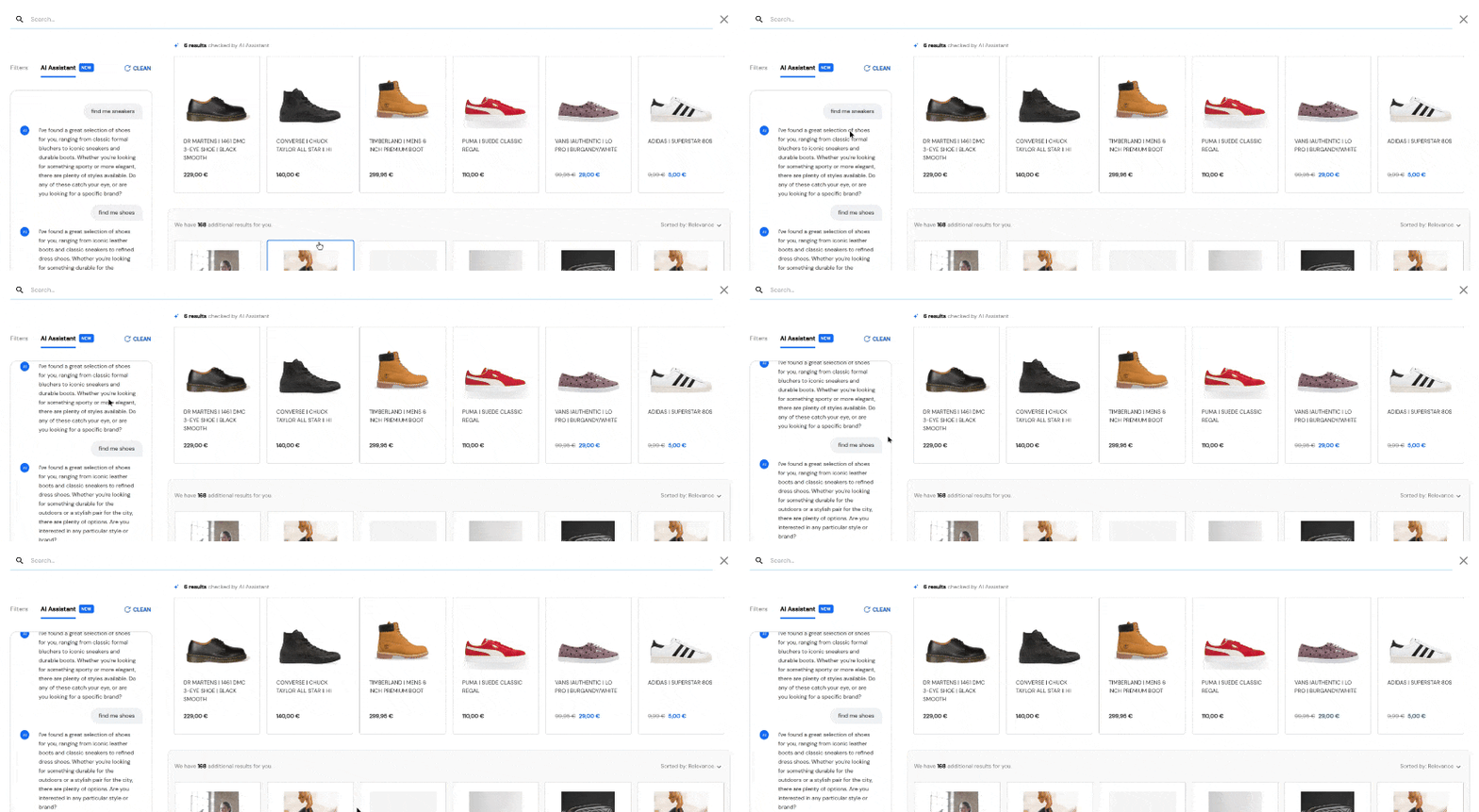
Doofinder’s AI Assistant sits on your product pages as a side panel, so shoppers can keep browsing while they ask. It answers from your product feed, product pages, FAQs and any documents you upload. When the answer isn’t in your store, it looks it up on the web. Ask it what a US 9 in Nike is in Adidas, and it checks the brand’s size chart.
Because search, recommendations and the assistant share one engine, what a shopper searches for shapes what the assistant suggests. Every conversation also feeds a report on what shoppers ask and what stops them buying, such as how often people question whether a product runs true to size.
Key features
- Free-text conversation on product pages and across the store
- Answers from catalog, store content and the web
- Same engine as Doofinder’s AI search, merchandising and recommendations
- Conversation insights in the Doofinder dashboard
- Setup in two toggles and a CSS selector, no developer needed
Platforms: native plugins for Shopify, WooCommerce, Magento, PrestaShop, BigCommerce, Shopware and 25+ more.
Pricing: on request. The AI Assistant is available on the Pro, Advanced and Enterprise plans, and there’s a 15-day free trial with no credit card required.
Results: Spanish toy retailer Eurekakids reports the assistant now handles 40% of its pre-purchase questions, alongside a 24% higher conversion rate and €12 more per order. See Doofinder customer stories.
Pros
- One engine for search, recommendations and assistance, so shoppers don’t need to leave the chat
- Answers questions your catalog doesn’t cover
- Plug and play on more platforms than any other tool in this list
Cons
- The assistant isn’t included in the Basic plan
- Live on 200+ stores, so the track record is younger than Rep AI’s or Gorgias’s
If you want to see it on your own catalog, you can try Doofinder free for 15 days.
Best AI shopping assistants for small and growing stores
These two tools go live without a developer and have entry plans built for stores that are still growing.
2. Rep AI
Best for: Shopify brands whose main problem is shoppers leaving, not shoppers asking hard questions.
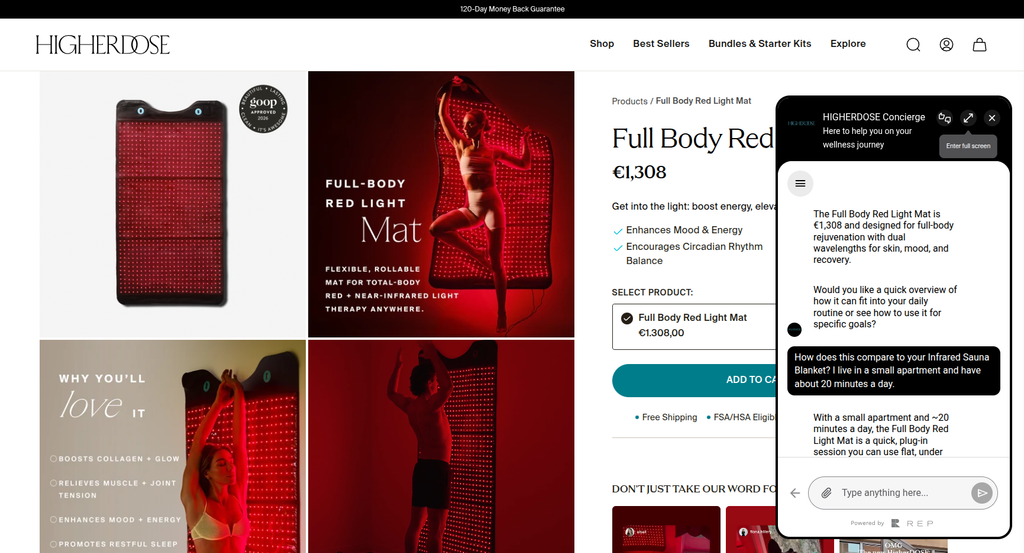
Rep AI watches what visitors do, such as repeat browsing, comparing products or heading for the exit. When it spots hesitation, it opens the conversation itself. It syncs your Shopify catalog and refreshes it every few seconds, then recommends and upsells inside the chat.
Key features
- Proactive conversations triggered by browsing behavior
- Recommendations, upsells and cross-sells in the chat
- Optional AI support agent with handoff to a human
- On-site chat plus email, Instagram, Facebook and WhatsApp
Platforms: built for Shopify, with headless setups for enterprise. Rep AI’s own company information describes WooCommerce support as coming soon and Salesforce Commerce Cloud as available to design partners only.
Pricing: billed on monthly sessions. The Sales agent, which is the shopping assistant, costs $104/month at 10,000 sessions on monthly billing, and paying yearly saves 20%. The Support agent is sold separately, or together with Sales as the Concierge bundle. There’s a 30-day free trial on all plans.
Pros
- One of the strongest proactive engagement in this list
- A 30-day free trial to test it on your own catalog
- Large review base on the Shopify App Store and G2
Cons
- Reviewers mention it can take about a month to reach full speed
- Some reviewers say answers need checking at first
- Recommendations come from the conversation, not from a search engine, which is less suited to technical catalogs
3. Gorgias
Best for: stores that already run customer support in Gorgias and want the same AI to start selling.
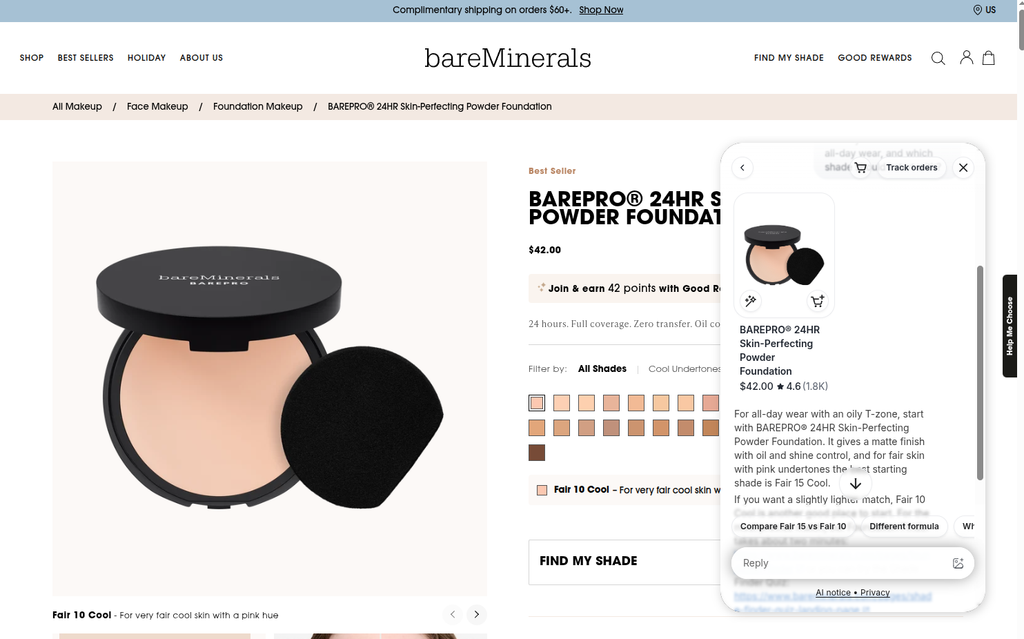
Gorgias is a helpdesk first. Its AI Agent has two roles: a Shopping Assistant before the purchase and a Support Agent after it. The Shopping Assistant answers product questions, recommends products from your Shopify catalog and can offer discounts. A selling-style setting controls how pushy it gets. It can also show AI-generated questions on product pages, so shoppers get answers without opening the chat.
Key features
- Product questions, recommendations and upsells in chat, email and SMS
- Conditional discounts during the conversation
- AI FAQs embedded on product pages
- Order actions like refunds and edits from the same inbox
Platforms: the AI Agent, including the Shopping Assistant, requires a connected Shopify store. Gorgias’s documentation states it isn’t supported on BigCommerce, Magento or WooCommerce, even though the helpdesk itself connects to those platforms.
Pricing: two meters. Each plan combines a helpdesk component, billed on tickets, with an AI Agent component that includes a set number of automated interactions. Basic with the AI Agent costs $90/month on monthly billing ($77/month billed annually) and includes 300 tickets and 30 automated interactions. Each automated interaction beyond that costs $1.50. You can’t use the AI without the helpdesk.
Pros
- One AI for pre-sale and support, in a tool many Shopify teams already use
- The biggest review base in this list
Cons
- Two meters make the monthly bill hard to predict
- Recommendations are made at product level, not per size or color variant
Best AI shopping assistants for mid-market brands
Mid-market stores usually have bigger catalogs, more traffic and someone whose job is conversion. These three tools reward that extra attention.
4. Dialog
Best for: brands with complex, technical or premium products that shoppers want explained before they pay.
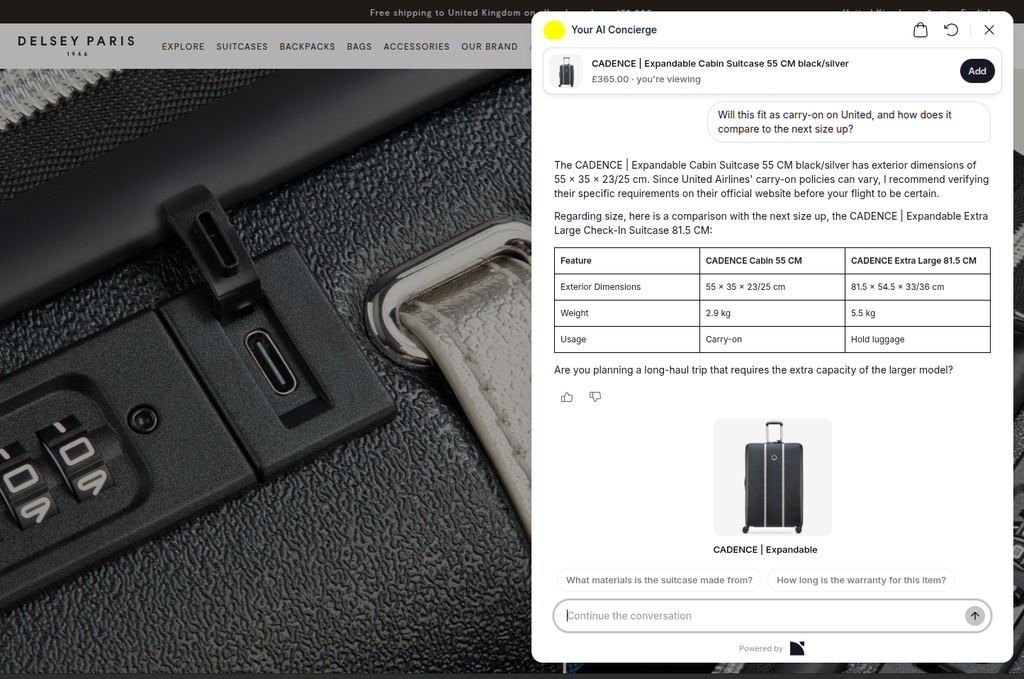
Dialog is a Paris-based startup founded in 2023. Its assistant is embedded in the product page rather than floating in a chat bubble, so it feels like part of the page. It answers technical questions, handles doubts and recommends across the catalog. It learns from your catalog, reviews, internal documents and blog articles. You can choose the underlying model, with ChatGPT, Claude and Mistral as options.
Key features
- Product page assistant plus a full personal-shopper mode
- Re-engagement for shoppers who asked but didn’t buy
- Built-in A/B testing, with results visible in Google Analytics 4
Platforms: Shopify, Salesforce Commerce Cloud, BigCommerce and PrestaShop.
Pricing: billed on unique monthly visitors, with no cap on conversations. There’s a free plan (200 conversations, basic AI model), then Starter at $249/month up to 25,000 visitors, Standard at $399 up to 50,000 and Scale at $799 up to 100,000. Paid plans bill every 30 days, and there’s a free trial.
Pros
- Flat pricing per traffic tier, so chatty shoppers don’t raise the bill
- Native A/B testing makes the lift easy to prove
- Easy testing the demo on your website before commiting
Cons
- No search engine of its own, so it works alongside whatever search you have
- Pre-sale only, so you still need a helpdesk after the purchase
- A smaller review base than the bigger names
5. Alhena AI
Best for: beauty and fashion brands that want visual tools as well as chat.
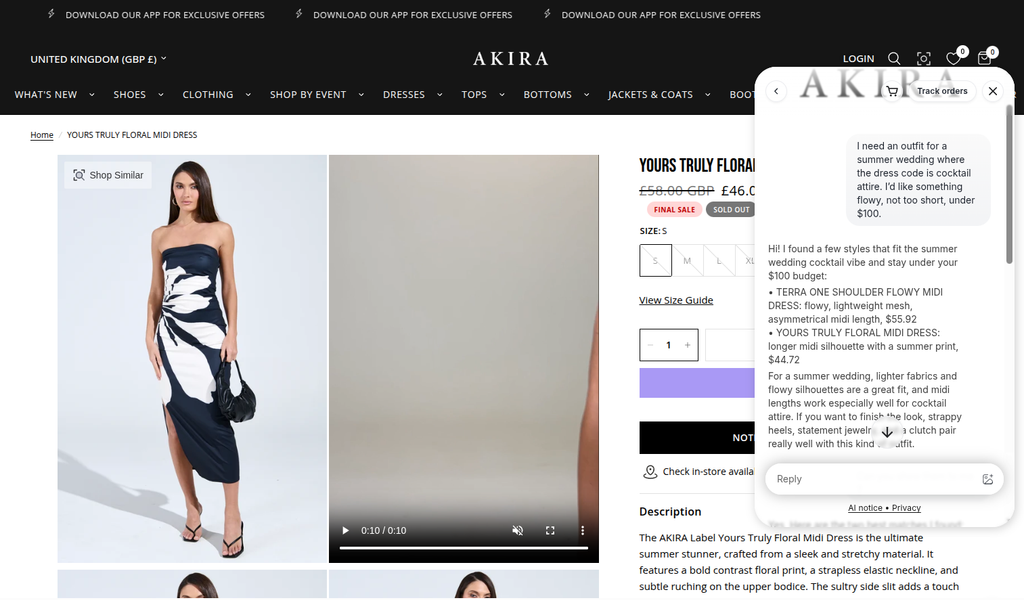
Alhena (called Gleen AI until early 2025) runs semantic searches against your catalog and grounds every answer in your product data. On top of the shopping assistant, it adds tools for the product page: virtual try-on, an outfit builder and a fit analyzer. It also covers support questions like returns and order tracking, so it can replace two tools.
Key features
- Conversational product discovery with comparisons and upsells
- Try-on, fit and styling tools on product pages
- One agent across web chat, email, social DMs and voice
- A tool that tracks how your products show up in ChatGPT and other AI answers
Platforms: Shopify, WooCommerce and Salesforce Commerce Cloud.
Pricing: billed per conversation. There’s a free plan (25 conversations). On annual billing, Essentials is $199/month (200 conversations), Growth $499 (550) and Scale $999 (1,200). Monthly billing costs $239, $599 and $1,199. Extra conversations cost $1.20 each, and paid plans start with a 14-day trial.
Pros
- The widest set of pre-sale tools on the product page
- Covers sales and support in one agent
- Product suggestions are relevant and closely match what the shopper asks for
Cons
- The bill grows with engagement, not with traffic
- Suggestions come as links to the product page instead of product cards in the chat
- Analytics are basic, according to reviewers
6. Luigi’s Box
Best for: European stores that want AI search and an assistant from one vendor and don’t mind buying them as separate modules.
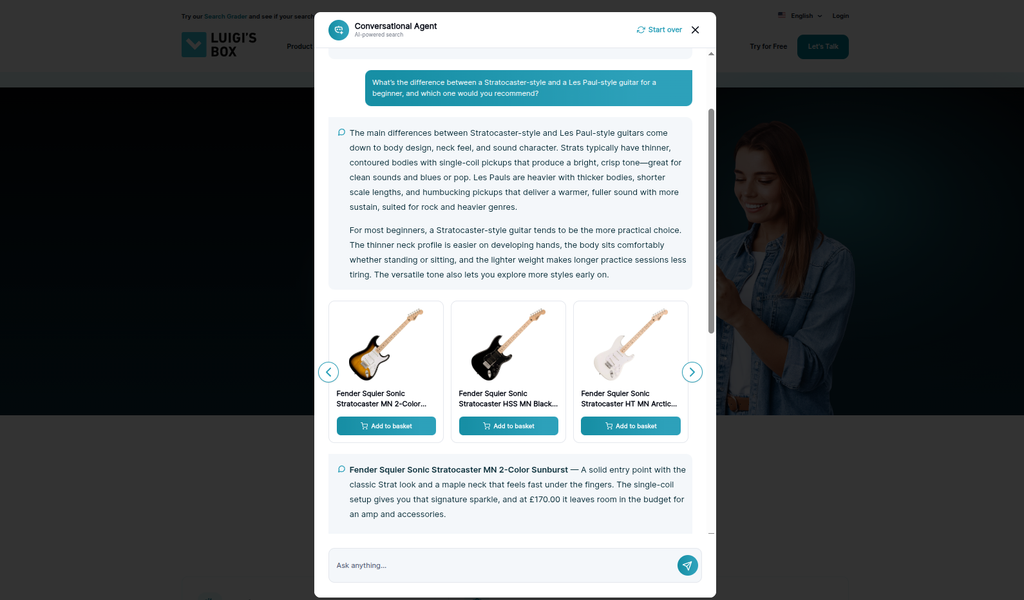
Luigi’s Box is a product discovery suite used by more than 4,000 online businesses. Its newer Conversational Agent lives in the search bar. It asks clarifying questions, offers clickable chips so shoppers can refine without typing, and steps in when a search returns nothing. It runs on the same catalog and script as Luigi’s Box search. The older Shopping Assistant is a guided question flow you design yourself, useful for structured decisions like picking a size or category.
Key features
- Conversational Agent in the search bar, on desktop and mobile
- Zero-results fallback that redirects to relevant products
- Guided Shopping Assistant with multilingual question flows
Platforms: native connectors for Shopify, Shoptet, Shopware, WooCommerce, PrestaShop and commercetools, plus integrations with Magento, BigCommerce and other platforms.
Pricing: on request. You choose which Luigi’s Box products to use, and the price depends on those products and your usage.
Pros
- Assistant and search share one engine and catalog
- Strong NLP and typo handling in search
Cons
- Modules are billed separately, so total cost needs a full quote
- The guided Shopping Assistant needs you to design the question flows yourself
Best AI shopping assistants for enterprise
At enterprise scale, the assistant is one piece of a larger platform. Neither tool below publishes prices, and both expect a project team.
7. Algolia Agent Studio
Best for: retailers with their own developers who want to build a custom assistant on top of Algolia search.
Agent Studio isn’t a ready-made assistant. It’s a toolkit that connects the large language model of your choice to your Algolia indices, so answers are grounded in live product data. With its templates and SDK, teams build an AI mode in the search bar, questions on product pages and guided discovery flows. In July 2026 Algolia added guardrails and cost controls that can be set per agent.
Key features
- Answers grounded in your product index, reviews, content and business rules
- Swap language models without rebuilding the integration
- AI mode in the search bar, product page questions and guided selling
- Guardrails and cost controls per agent
Platforms: any, via API and SDK.
Pricing: based on usage. Every search request an agent makes counts toward your Algolia search usage and can add charges. You connect your own LLM provider, so model costs are billed by that provider. Agent Studio launched in public beta in September 2025 and became generally available in autumn 2026.
Pros
- High control over how the assistant behaves
- Built on a proven enterprise search engine
Cons
- Needs developers to build and maintain
- Usage-based cost is hard to forecast when agents run many queries per conversation
- Only generally available since autumn 2026, so the production track record is short
8. Bloomreach Loomi
Best for: enterprise retailers that already use Bloomreach for search, email or personalization.
Bloomreach’s conversational shopping agent runs on its Loomi AI platform, which combines customer data, search and merchandising rules. It asks qualifying questions and starts conversations on product and category pages, even when a shopper hasn’t searched. It can pull in reviews and hand the conversation to a human agent with full context.
Key features
- Proactive conversations on product and category pages
- One customer data layer across chat, email, SMS and web
- Handoff to service agents with conversation history
Platforms: Shopify, Magento, BigCommerce, headless and custom builds.
Pricing: on request. Conversational Shopping is its own module on Bloomreach’s pricing page: you pay a module fee plus a usage fee, and the agent’s tiers scale with monthly unique visitors. There’s no self-serve plan, but Bloomreach offers a custom Chrome extension to test the agent on your own site.
Pros
- Deep personalization from a full customer data platform
- Strong omnichannel context
Cons
- Bigger platform than most stores need
- No public pricing
- A steep learning curve, according to reviewers
Other AI assistants for eCommerce worth a look
These tools didn’t get a full review, but each fits a specific situation.
- Clerk.io. Search, recommendations, email and an AI chat in one platform, used by 2,500+ stores. The chat handles budgets, stock checks and exit-intent conversations, and also answers order questions.
- Constructor. An enterprise product discovery platform with an AI Shopping Agent for natural-language shopping and a Product Insights Agent that answers questions on product pages. Since October 2026, shoppers can also check out inside the agent through Stripe.
- Klaviyo AI Shopping Assistant. A sensible add-on if Klaviyo already runs your email and SMS, since the same agent carries the conversation across chat, text and email.
- Manifest AI. A library of 500+ prebuilt agents for Shopify, from sales and fit prediction to post-purchase follow-up.
Do you need an AI shopping assistant, or better search?
An assistant is the newest tool on this list, but it’s not always the first thing to fix. Start with where your shoppers get stuck today.
| If your shoppers… | Start with | Why |
|---|---|---|
| Mostly know what they want, but search misses it | Better AI search | Typos, synonyms and empty results lose sales before any conversation starts |
| Hesitate on product pages and leave | An AI shopping assistant on the product page | Doubts about fit, materials or compatibility are decision questions, not search queries |
| Mostly ask about shipping and returns | A support bot or AI Assistant | The assistant answers questions based on any documentation |
| Browse a large catalog without a clear goal | AI Assistant | The assistant narrows the choice, and the right choice of products products |
If you’re not sure where you stand, look at your search data first. Your zero-results rate and your most common queries show quickly whether search is the bottleneck. Fix your no results page and site search best practices are good places to start.
What about ChatGPT, Gemini and other consumer AI shopping agents?
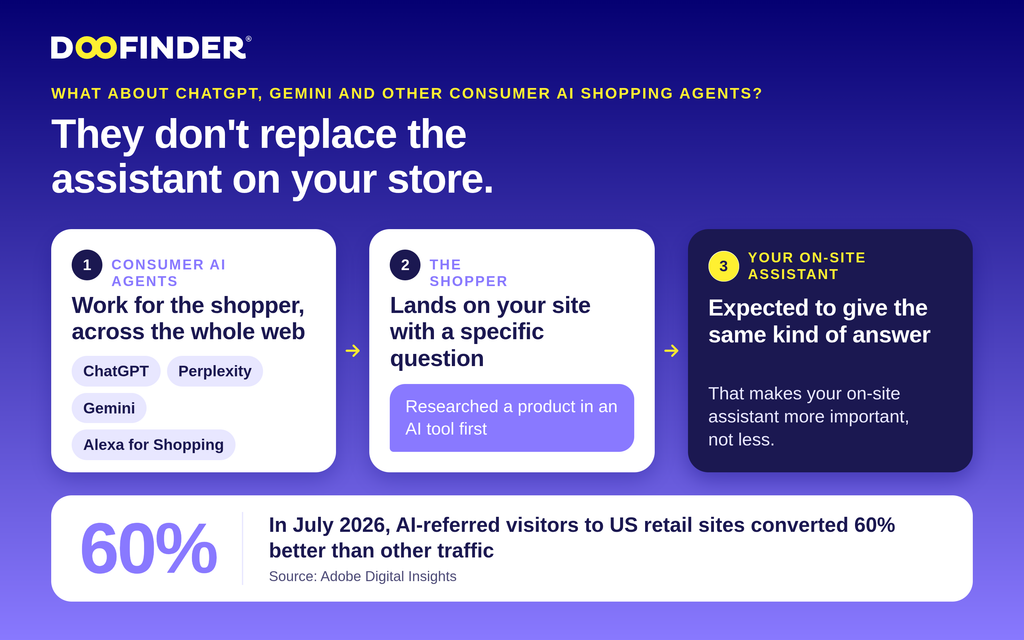
Shopping agents like ChatGPT, Perplexity, Gemini and Amazon’s Alexa for Shopping work for the shopper, across the whole web. They don’t replace the assistant on your store. They do change who arrives there: shoppers who researched a product in an AI tool land on your site with a specific question and expect the same kind of answer. In July 2026, AI-referred visitors to US retail sites converted 60% better than other traffic, according to Adobe Digital Insights.
That makes your on-site assistant more important, not less. It’s also why tools like Alhena now include features to help your products show up in those AI answers. Read more in our guide to conversational commerce.
How to choose an AI shopping assistant
Demos all look good. These questions show what a tool does on your store, with your catalog.
Six questions to ask every vendor
- Where do the answers come from? Ask which sources it reads (catalog, reviews, documents, the web) and what it does when the answer isn’t there.
- What search engine is underneath? A chat layer on weak search gives friendly answers with the wrong products.
- Where does it appear? Product page, search bar, chat bubble or proactive pop-up each fit different moments.
- What is the billing unit? Visitors, sessions, conversations, tickets and search requests all scale differently.
- How do you measure the lift? Look for a comparison of assisted and unassisted sessions, ideally with A/B testing.
Check your product data first
Every assistant on this list is limited by your catalog. Missing attributes, thin descriptions and inconsistent categories lead to vague answers, whichever tool you buy. Fix the biggest gaps before launch, or pick a tool that enriches product data for you.
Which AI shopping assistant should you choose?
If you want one engine for search, recommendations and an AI shopping assistant that you can set up yourself, try Doofinder. It works on 30+ platforms, fills gaps in your product data with AI Visual Tagging, and shows you what shoppers ask in every conversation. Set it up on your own catalog and see what it does with your hardest product questions.
Try Doofinder free for 15 days, no credit card required.
Frequently Asked Questions
There’s no single best AI shopping assistant. For mid-market and enterprise stores that want search and the assistant on one engine, Doofinder is a strong pick. Enterprise teams looking for a higher amount of customization and an in-house developer team available could look at Algolia Agent Studio or Bloomreach Loomi.
AI search helps shoppers who know roughly what they want find it fast. An AI shopping assistant answers the questions in between, like whether a product fits, how two options compare or what a material is. The best results come when both run on the same engine and catalog.
They can, mainly on product pages where shoppers hesitate. Eurekakids, a Doofinder customer, reports a 24% higher conversion rate since launching the AI Assistant. Results depend on your product data and on where the assistant appears, so measure assisted against unassisted sessions.
All nine tools in this guide work with Shopify. Rep AI and Gorgias are built mainly for it. Doofinder, Dialog and Alhena AI also run on other platforms, which matters if you might migrate later.
Usually not. Most shopping assistants focus on the moment before purchase, while support bots handle orders, returns and shipping. Some tools, like Gorgias and Alhena AI, cover both. Doofinder’s AI Assistant is designed to work next to your existing support tool.
You can try Doofinder’s AI Assistant free for 15 days, with no credit card needed. That’s long enough to set it up on your own catalog and see how it answers real shopper questions before you commit. Some other tools have permanent free plans, such as Dialog (200 conversations a month) and Alhena AI (25 conversations), but those are limited to small volumes and basic features. For a busy store, a full-featured free trial tells you more than a capped free plan.