
Product search is the search bar on your online store. It’s how shoppers tell you exactly what they want to buy, right when they’re ready to buy it.
Most stores still run that search bar on plain keyword matching. It looks for the exact words a shopper typed somewhere in your product data. Type something different, a typo, a description, a full sentence, and results often come up empty, even when the product exists.
This guide looks at how that gap is handled: how AI interprets queries, connects different ways of describing the same product, uses context to rank results, and learns from what shoppers do after they search.
What Is AI Product Search?
AI product search uses machine learning and language understanding to interpret what a shopper means, rather than relying solely on exact keyword matches. Depending on the search platform, this can include natural-language processing, semantic matching, typo tolerance, synonyms, personalization, and visual search.
At its best, AI search creates a bridge between how shoppers describe what they want and how a retailer describes what it sells.
Those two vocabularies are often very different. A catalogue might say “water-resistant insulated parka,” while a shopper might search for “a warm coat for rainy commutes.” Good search has to recognise that these can describe the same underlying need.
How It’s Different From Keyword Search
Traditional keyword search is fairly straightforward. It looks for products where the title, tags, or description contain the words a shopper has typed.
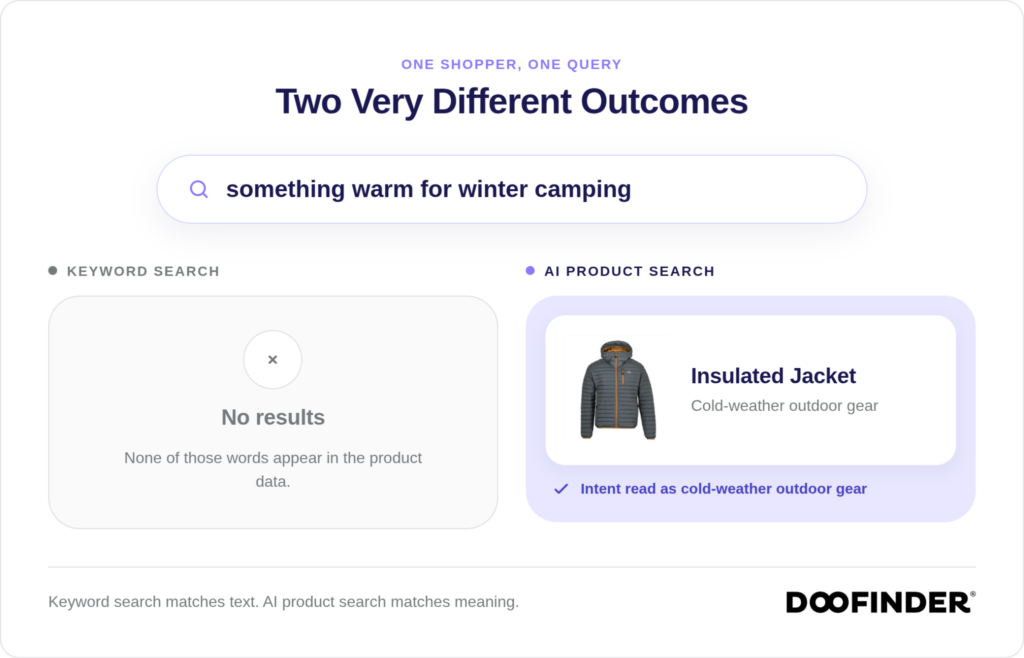
For example, someone might search for “jackt” instead of “jacket”, or type “something warm for winter camping” when the product is actually described as an “insulated jacket”. A keyword-based search may struggle with both queries because the words don’t match, even though the right product is in the catalogue.
AI product search takes a different approach. Rather than relying only on matching words, it tries to understand what the shopper is actually looking for.
The AI Capabilities That Make Search Intelligent
A handful of AI capabilities work together to make this possible:
- Natural language processing (NLP), which parses full sentences and conversational queries
- Semantic matching, which connects a query to relevant products even without exact keyword overlap
- Personalization, which adjusts results based on a shopper’s behavior
- Typo tolerance and synonym recognition, which catch spelling mistakes and alternate phrasing
- Visual recognition, which can tag or search products by image
We’ll walk through each of these below.
Worth a quick note: AI product search here means AI built into your own store’s search bar, not general AI tools like ChatGPT or Google AI Mode that search the whole web. Those tools help shoppers browse anywhere. AI product search focuses that same intelligence on the moment a shopper is already on your site and ready to buy.
Basic Keyword Search vs. AI-Powered Search
The clearest way to understand AI product search is to see it next to the alternative.
Handling Typos, Natural Language, and Ambiguous Terms
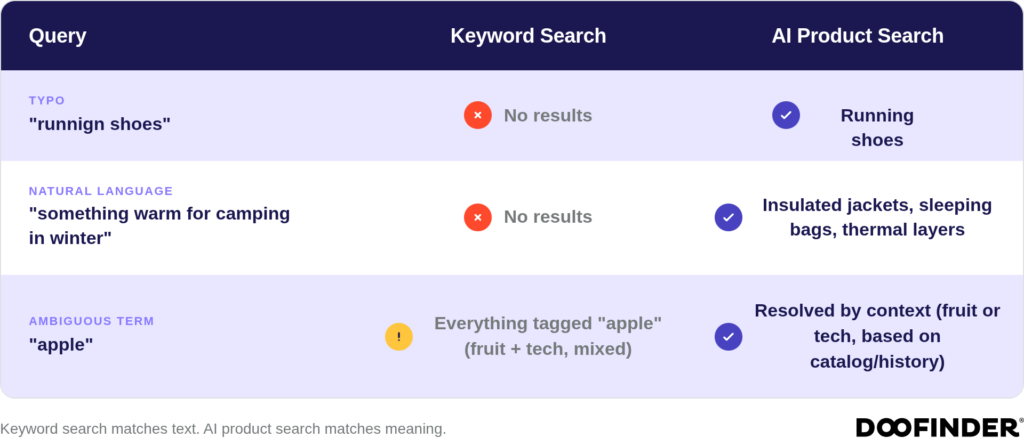
Take three common search scenarios:
- Typos: a shopper searches “runnign shoes.” Keyword search may return zero results. AI-powered search recognizes the intended word and returns running shoes anyway.
- Natural language: a shopper searches “something warm for camping in winter.” Keyword search looks for a literal match and likely fails. AI-powered search interprets the intent (cold-weather outdoor gear) and surfaces insulated jackets, sleeping bags, and thermal layers.
- Ambiguous terms: a shopper searches “apple.” Is that a fruit, or a tech brand? AI-powered search uses context (the store’s catalog, the shopper’s browsing history, category signals) to resolve the ambiguity. Keyword search just returns everything tagged “apple.”
The Same Query, Two Different Outcomes
Personalization makes this even more concrete. Take two different shoppers on the same store, both searching “gloves.” One has recently been browsing boxing equipment. The other has been looking at dress pants and jackets. With AI-powered search, the first shopper’s top result is boxing gloves. The second sees leather gloves. Same query, same store, two different and more relevant outcomes, because the search engine factors in real-time behavioral signals instead of returning a static, one-size-fits-all list.
Why AI Product Search Matters for Your Store
Search isn’t a side feature. For most stores, it’s where your highest-intent shoppers tell you exactly what they want to buy.
The Cost of a Search Bar That Doesn’t Understand Shoppers
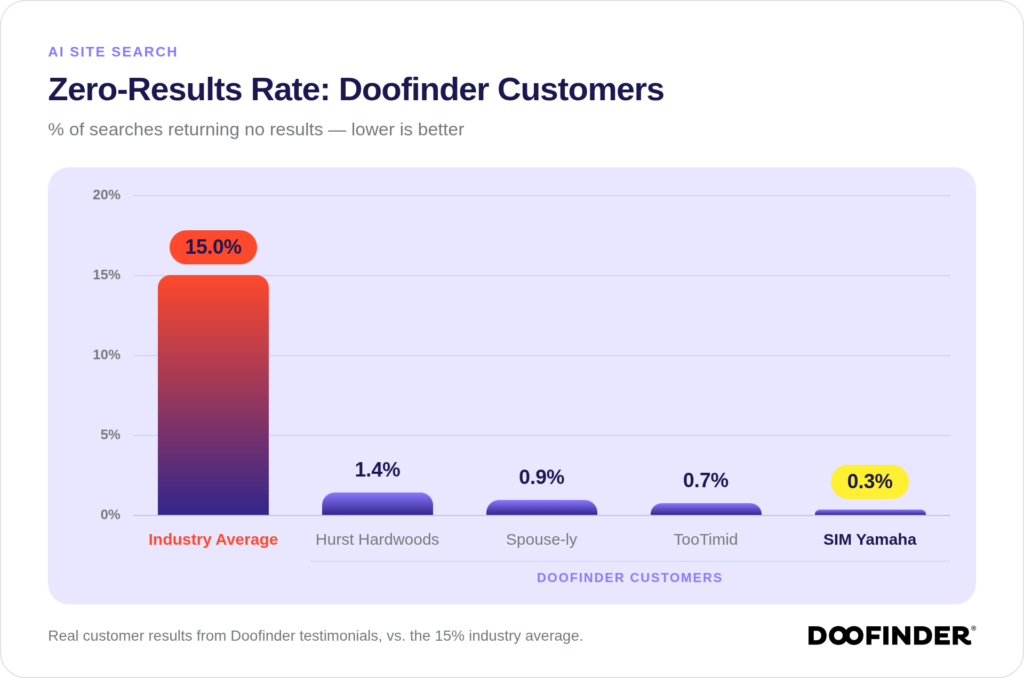
68% of shoppers report being unhappy with on-site search, and most don’t give it a second try. Every zero-results search is a customer who told you exactly what they wanted and left empty-handed anyway. The average eCommerce store has a 15% zero-results rate. For stores using Doofinder, that average drops below 1%.
The Conversion Case for AI Search
The impact shows up directly in the numbers. TooTimid struggled with irrelevant results burying the products customers actually wanted. After switching to AI-powered, relevance-first search, zero-results queries dropped to 0.7%, conversion rate rose to 10.3%, and revenue lifted 7.1%. Wired 4 Signs USA sees 17x higher purchase likelihood when sessions involve search. FoundGolfballs drives 45% of total revenue through search. SempreFarmacia runs a 13.8% conversion rate on search sessions.
Where AI Search Fits in the Bigger Discovery Picture
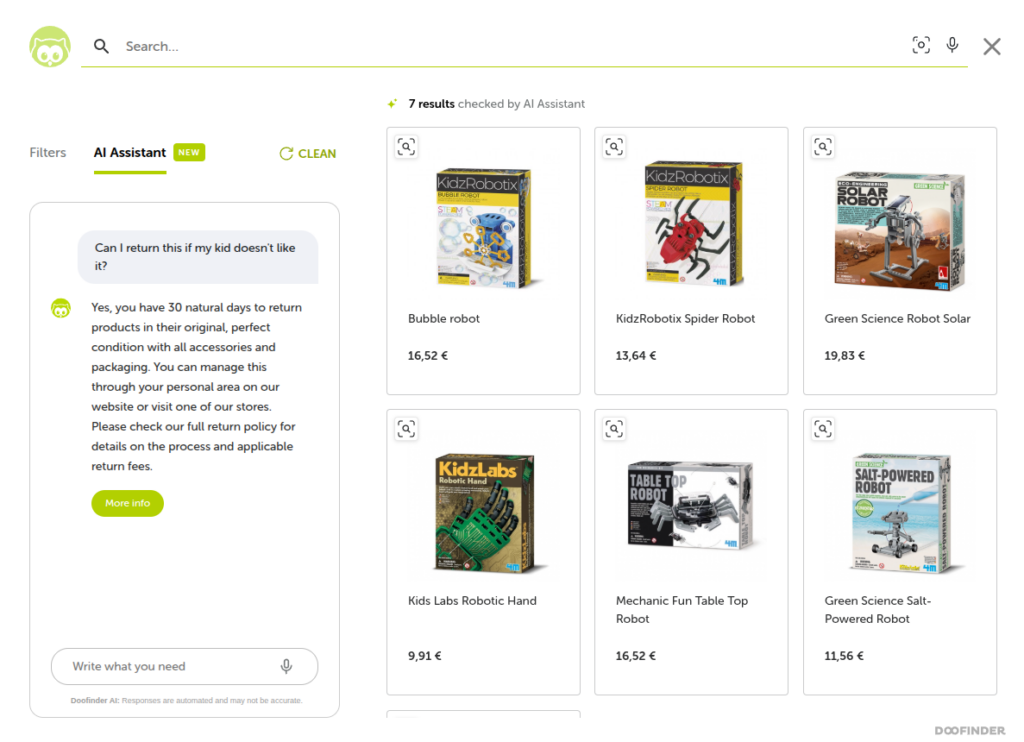
AI product search rarely works alone. It’s typically one part of a broader discovery layer that includes personalized recommendations, merchandising controls (boosting key products, seasonal banners, custom or excluded results), and increasingly, conversational assistants that let shoppers ask questions in plain language instead of typing keywords at all.
At Eureka Kids, an AI shopping assistant now handles 40% of pre-purchase questions that used to go to a support agent. Search is the entry point. These other layers decide what happens next.
The AI Capabilities Behind Product Search
Here’s a closer look at the specific AI capabilities that power intelligent product search.
Query Understanding (NLP)
Natural language processing lets a search engine interpret full sentences and conversational phrasing, not just isolated keywords. This is also the foundation behind AI shopping assistants, which let customers ask for what they need the way they’d ask a salesperson. Natural language search helps search engines understand these more conversational queries.
Semantic Matching
Semantic search is designed to find products that are related in meaning even when the query and product data don’t share the same wording.
That makes it particularly useful for descriptive searches. Someone searching for “shoes for standing all day” doesn’t necessarily care whether a product page contains those exact words. They’re signalling a need for comfort and support. A semantic search system can use that meaning to identify products that are likely to fit the need.
But semantic relevance isn’t the same thing as perfect relevance. Product data, category structure, ranking logic, and business rules still influence what ultimately appears.
Personalization
As shown in the gloves example above, AI-powered search adjusts results in real time based on a shopper’s session behavior: pages viewed, items clicked, and products added to cart. Search personalization helps make those results more relevant to each individual shopper.
Visual Tagging and Synonym Detection
AI can automatically tag product attributes like color, style, or material directly from product images, which helps stores with thin or inconsistent catalog data. Visual search can use these visual attributes to help shoppers discover relevant products. AI can also detect and suggest synonyms, so a search for “sofa” also catches products only labeled “couch.”
Merchandising and Business Rules
AI search doesn’t have to be a black box. Merchants can still apply business rules on top of it: boosting high-margin products, running seasonal campaigns, or excluding out-of-stock items from results. AI improves relevance without taking away control.
Where AI Product Search Can Still Go Wrong
AI can make search more flexible, but it doesn’t fix every search problem automatically. The quality of the results still depends on your product data, ranking rules, and how the system interprets shopper behaviour.
Poor Product Data
If product attributes are missing or inconsistent, AI has less reliable information to work with. Better search can’t fully compensate for a poorly maintained catalog.
Over-Personalization
Personalization can improve relevance, but too much can make assumptions that aren’t justified. Someone who browsed men’s clothing yesterday isn’t necessarily looking for men’s products today.
Irrelevant Semantic Matches
Semantic search can understand related concepts, but related doesn’t always mean relevant. A search for “running shoes” shouldn’t return every product associated with sports or trainers.
AI Needs Guardrails
Conversational search also introduces another challenge: AI-generated answers need to be grounded in accurate product information. Otherwise, a system can produce a convincing answer that isn’t actually supported by the catalogue.
AI can automate more of the matching process, but merchants still need to monitor results, adjust rules, and fix problems in the underlying catalogue.
How Do You Measure AI Product Search?
AI search shouldn’t be judged simply by whether it returns products. The real measure is whether it helps shoppers find relevant products and move closer to a purchase.
The most important metrics to monitor are:
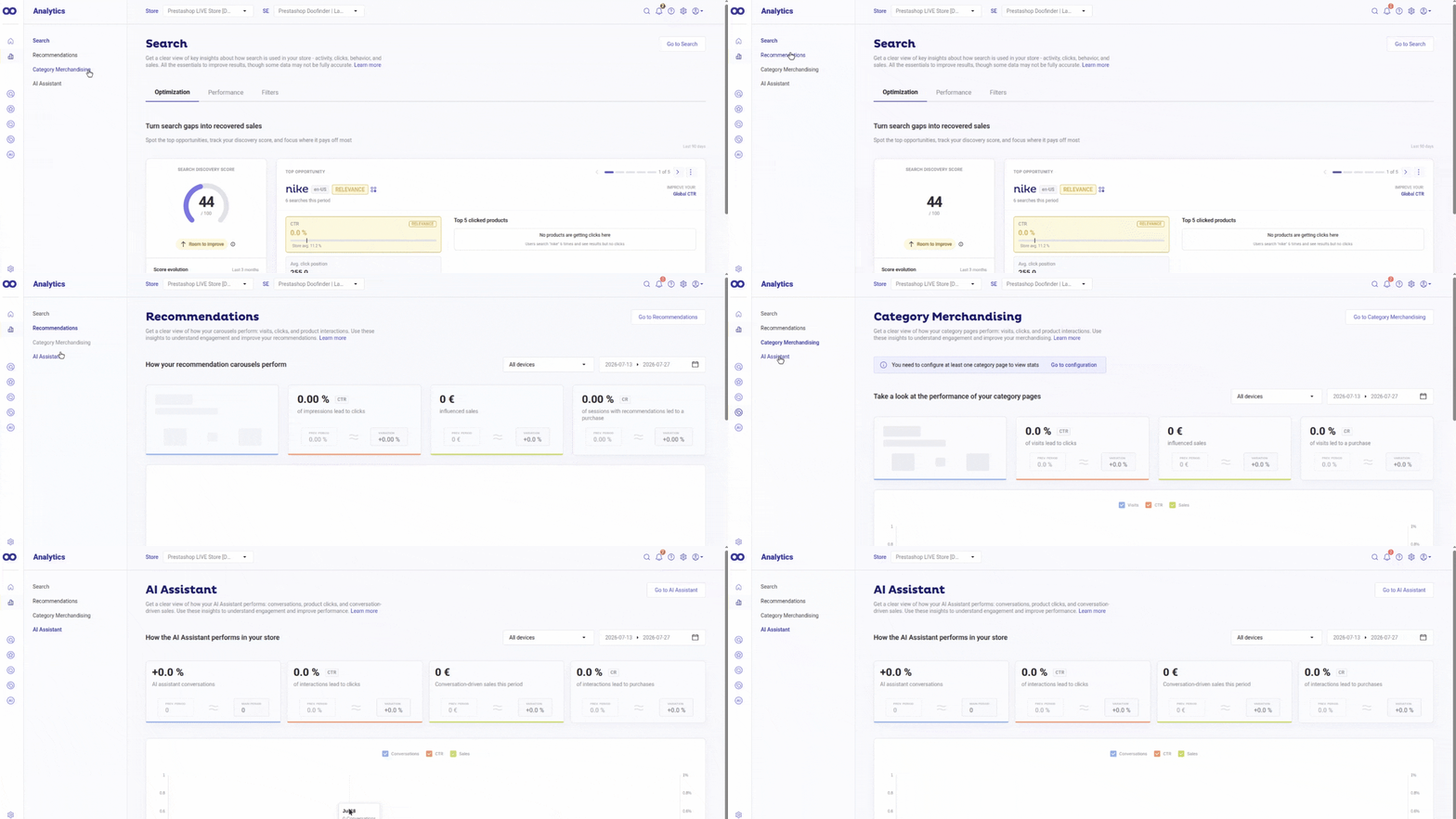
- Zero-results rate: How often do shoppers search for something but find nothing relevant? A high rate can reveal gaps in your catalogue or areas where search relevance needs improvement.
- Click-through rate: Are shoppers clicking the products returned for their searches? A low click-through rate can indicate that results aren’t matching shopper intent.
- Search conversion rate: How often do shoppers who use search go on to make a purchase? This helps connect search performance directly to revenue.
- Top and high-opportunity searches: Which terms are shoppers searching for most, and which searches generate lots of activity but poor engagement or no results? These queries can reveal unmet demand and opportunities to improve your catalogue, content, synonyms, or merchandising.
Together, these metrics show not just what shoppers are searching for, but whether your search experience is successfully connecting them with the right products.
Learn more about eCommerce search analytics
How to Know If Your Store Is Ready for AI Search
Not every store needs to jump straight to the most advanced AI capabilities. Here’s a simple way to think about where your search currently stands.
The 5 Levels, From Basic Keyword Matching to Fully AI-Driven Search
Think of search maturity as a progression rather than a simple choice between “keyword” and “AI.”
Level 1 — Keyword matching: The engine primarily looks for words that appear in product data.
Level 2 — Assisted search: Autocomplete, typo tolerance, spelling correction, and basic query suggestions make it easier to reach a valid query.
Level 3 — Language understanding: NLP and synonyms help the engine interpret longer queries and different ways of describing the same thing.
Level 4 — Contextual relevance: Semantic matching and behavioural signals help determine which products are most relevant to a particular query and shopper.
Level 5 — Connected search: Search works alongside merchandising, recommendations, analytics, and conversational experiences, creating a broader product-discovery system rather than an isolated search box.
The levels aren’t necessarily mutually exclusive. Most mature ecommerce search experiences combine several of them.
Quick Self-Assessment
Use the quick self-assessment below to see where your store’s search stands today and identify opportunities to improve it.
Check the ones your store already has. Anything you leave unchecked counts as a no.
If your search experience is still relying heavily on keywords, struggling with natural-language queries, or returning too many zero-result searches, AI-powered search could make a meaningful difference to how shoppers discover products on your store.
Want to see what AI-powered search can do for your store? Try Doofinder free for 15 days and see how smarter search can help shoppers find the right products faster.
Frequently Asked Questions
AI product search uses artificial intelligence, including natural language processing and semantic matching, to understand shopper intent and return relevant products, even when a query is vague, misspelled, or phrased conversationally.
AI improves product search by interpreting meaning instead of matching exact keywords, tolerating typos, understanding natural language queries, and personalizing results based on shopper behavior.
No. AI changes how on-site search works, but shoppers who are already on your store have higher intent than someone browsing ChatGPT or Google. AI product search improves that experience instead of replacing the need for it.
The best AI search solution depends on your platform, catalog size, and technical resources. Look for one that combines NLP, semantic matching, personalization, and merchandising controls without requiring custom development.
AI-powered search platforms typically price by catalog size and traffic. Doofinder’s plans, for example, start at $49/month for growing stores, with a 15-day free trial.