
Most people think search is mainly about keywords or AI. In reality, the best search experiences combine AI with something equally fundamental: metadata search.
Every time a user filters products by size, color, price, or availability, they are relying on metadata. While AI helps interpret intent and improve relevance, structured product data provides the context search engines need to return accurate results quickly and consistently.
Metadata search is the practice of retrieving and ranking content using structured information about products, pages, or images, alongside other search techniques. It plays a central role in modern search engines, especially in eCommerce and site search, where precision, control, and scalability are essential.
In this article, we will explain how metadata search works, why it matters, and how it supports everything from product filters to image search and AI-driven discovery.

What Is Metadata in Search Engines?
To understand metadata search, it helps to start with the basics and look at how search engines actually use metadata behind the scenes.
Metadata gives search engines context
Metadata is structured information that describes content, products, or digital assets. It is not the main text users read, but the information that tells a search engine what that content represents and how it should be treated.
In search engines, metadata commonly includes product categories, attributes like size or color, content type, creation and update dates, brand, price, availability, and language. This structured data allows the search engine to interpret content consistently across large catalogs or websites.
Why metadata matters for search
When people ask what metadata is in search engines, the simplest answer is that metadata explains what something is, not just what words appear in it.
Search engines rely on metadata to index content correctly, apply filters, and decide which results are relevant for a specific query. This applies to public search engines like Google as well as eCommerce and site search platforms.
At Doofinder, product metadata such as categories, brands, and attributes plays a central role in delivering accurate results and meaningful filters. The quality of this metadata directly affects how well users can find what they are looking for.
User behavior shows how important structured data is for search. Studies consistently find that shoppers who use on-site search and filters convert significantly more than those who don’t, often accounting for a disproportionate share of eCommerce revenue. Filters and facets are powered by metadata, which means the quality of product metadata directly affects discoverability, relevance, and conversions.
Metadata makes precise search possible
Metadata turns raw content into structured, searchable information. It enables features like filtering, sorting, and faceted navigation, which help users narrow down results quickly and with confidence.
Without metadata, search engines must rely mostly on full text matching. That often results in broader, less precise results and a weaker search experience overall.
How Metadata Search Engines Work
A metadata search engine works by searching structured fields instead of, or in addition to, raw text. This is what allows search engines to deliver fast, precise results and powerful filtering options.
From data to searchable metadata
Before any search happens, metadata is collected from different sources such as product catalogs, content management systems, or databases. Each piece of metadata is mapped to a specific field, like category, brand, price, or availability.
This step is important because search engines need to know what type of data they are working with. A date should behave like a date, a number like a number, and a category like a category.
Indexing metadata for fast retrieval
After metadata is collected and mapped, it needs to be indexed so it can be searched and filtered efficiently. Indexing is what turns product data into a structure that search engines can use in real time.
In search platforms like Doofinder, different types of metadata are indexed according to how they will be used. Text fields such as product names or brands support relevance and matching, while structured fields like price, availability, category, or size are indexed to enable filtering, sorting, and boosting.
Normalization also plays an important role in this process. Metadata values are cleaned and standardized before indexing to avoid duplicated filters, inconsistent labels, or fragmented results. This ensures that similar products behave consistently in search results.
Because indexed metadata is stored in optimized data structures, search engines can apply filters and sorting rules instantly without scanning full product descriptions. This allows users to narrow results by attributes such as size, color, price range, or stock status, even in large catalogs.
For eCommerce search engines like Doofinder, efficient metadata indexing is essential for maintaining both speed and control, ensuring search results reflect availability, business rules, and user intent.
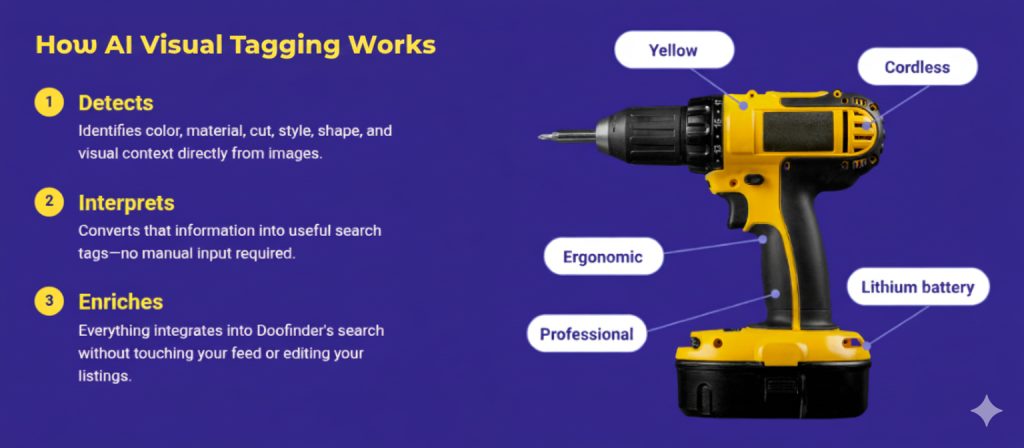
AI Visual Tagging enhances metadata quality and search relevance.Doofinder’s AI Visual Tagging analyzes product images and automatically detects visual features such as color, style, material, and shape, then converts them into structured tags that can be indexed and used in search queries. This enriches your metadata layer without manual effort and makes products easier to discover even when text descriptions are lacking or inconsistent.
Using metadata at query time
When a user performs a search, the search engine uses metadata to filter, boost, or rank results. For example, it might prioritize in-stock products, boost certain categories, or exclude items that do not match selected filters.
This is where metadata search really shines. Instead of scanning entire documents, the search engine can make precise decisions based on structured data, resulting in faster responses and more relevant results.
Metadata Search vs Full-Text Search vs Vector Search
Not all search techniques work the same way, and understanding the differences helps explain why metadata search is so important.
Full-text search focuses on words
Full-text search looks for matching words or phrases inside documents or product descriptions. It is useful for broad discovery and simple queries, but it often struggles with precision.
If a product description mentions a word once, it might rank even if the product is not actually relevant. Full-text search also makes it hard to filter or control results in a meaningful way.
Vector search focuses on meaning
Vector search uses machine learning models to represent content as embeddings. This allows search engines to find results that are semantically similar, even if they do not share the same keywords.
While powerful, vector search can be difficult to control and explain. It also relies heavily on good data and can return unexpected results without clear reasons.
Metadata search focuses on structure and control
Metadata search works with structured fields such as category, brand, attributes, and availability. It allows search engines to filter, rank, and organize results with precision.
In eCommerce and site search, metadata search is what makes features like faceted navigation and filtering possible. Platforms like Doofinder combine metadata search with other techniques to balance relevance, control, and performance.
Why modern search engines combine all three
Most modern search engines use a hybrid approach. Metadata search narrows and structures the results, while full-text or vector search helps fine-tune relevance.
Metadata provides the control layer that keeps search predictable and usable, especially at scale.
Enjoying this article?
Subscribe to make sure you always receive the latest eCommerce insights
Metadata Search Tools and Platforms
Metadata search is not a standalone feature. It is a core capability that appears across many different search tools and platforms, especially where large volumes of structured data need to be searched quickly, accurately, and at scale.
Different platforms use metadata search in different ways, but the underlying principles remain the same.
Metadata search in eCommerce search platforms
In eCommerce, metadata search is fundamental. Product catalogs are built almost entirely around structured data such as categories, attributes, prices, brands, and availability. Search engines use this metadata to power filters, sorting options, and relevance rules.
eCommerce search platforms like Doofinder rely on product metadata to deliver precise results. When a user filters by size, color, or price range, or when in-stock products are prioritized over unavailable ones, metadata search is working behind the scenes.
This is also what allows eCommerce search engines to maintain control over relevance. Instead of relying only on product descriptions, metadata ensures that search results reflect business rules and user intent at the same time.
Metadata search for filters, facets, and navigation
One of the most visible uses of metadata search is faceted navigation. Facets are built directly on metadata fields such as category, brand, price range, or attribute values.
Because these fields are structured and indexed, users can narrow down results instantly without re-running expensive full-text queries. This is critical for performance and usability, especially in large catalogs.
At Doofinder, filters and facets are powered by product metadata, allowing users to refine results quickly and confidently. The quality and structure of this metadata directly impact how intuitive and effective navigation feels.
Metadata search in site and content search
Metadata search is also widely used in site search for blogs, documentation, help centers, and knowledge bases. In these cases, metadata such as content type, publication date, author, topic, or language helps users narrow results and helps search engines surface the most relevant pages.
This is particularly important for large websites where full-text search alone would return too many results. Metadata allows search engines to distinguish between similar pieces of content and present them in a more useful way.
For example, filtering results to show only guides, documentation, or recent articles is only possible through metadata search.
Metadata search in digital asset management systems
Digital asset management systems rely heavily on metadata search. Images, videos, and documents are typically retrieved using metadata such as file type, creation date, usage rights, owner, or tags.
Without metadata, searching through large media libraries would be slow and unreliable. Metadata search enables teams to find assets quickly and ensures that content is reused correctly and consistently.
This reinforces an important pattern: when precision matters, metadata search becomes the primary retrieval method.
Metadata search in internal and enterprise systems
Metadata search also plays a key role in internal search engines and enterprise platforms. Documents, records, and data sets are often classified using metadata such as department, confidentiality level, status, or project name.
In these environments, metadata search supports governance, access control, and compliance. It allows systems to return only the results a user is allowed to see and to organize information in a predictable way.
While the use case differs from eCommerce, the mechanics are the same. Structured metadata provides clarity, control, and scalability.
What all metadata search platforms have in common
Across eCommerce search engines like Doofinder, site search platforms, digital asset management systems, and internal tools, metadata search follows the same principles.
Metadata provides structure and constraints. Other search techniques, such as full-text or semantic search, can then refine relevance within those boundaries.
This combination is what allows modern search platforms to scale while remaining fast, accurate, and easy to use.
Conclusion: Metadata Search Is the Foundation of Effective Search
Metadata search may not be the most visible part of a search experience, but it is one of the most important. It provides the structure that allows search engines to understand content, apply filters, and deliver relevant results at scale.
From eCommerce and site search to digital asset management and internal platforms, metadata search enables precision, speed, and control. It works alongside full-text and semantic search to create search experiences that are both flexible and predictable.
At Doofinder, we see every day how high-quality metadata improves search relevance and user satisfaction. When metadata is well structured and consistently applied, search becomes easier to tune, easier to trust, and more effective for both users and businesses.
As search engines continue to evolve, metadata search will remain a foundational layer. Not because it is new, but because it is reliable, explainable, and essential for delivering meaningful search experiences.